" /> Original Sin and Its Penalty
Central Kentucky Bible Students


Replacing Christ with the Watchtower Organization
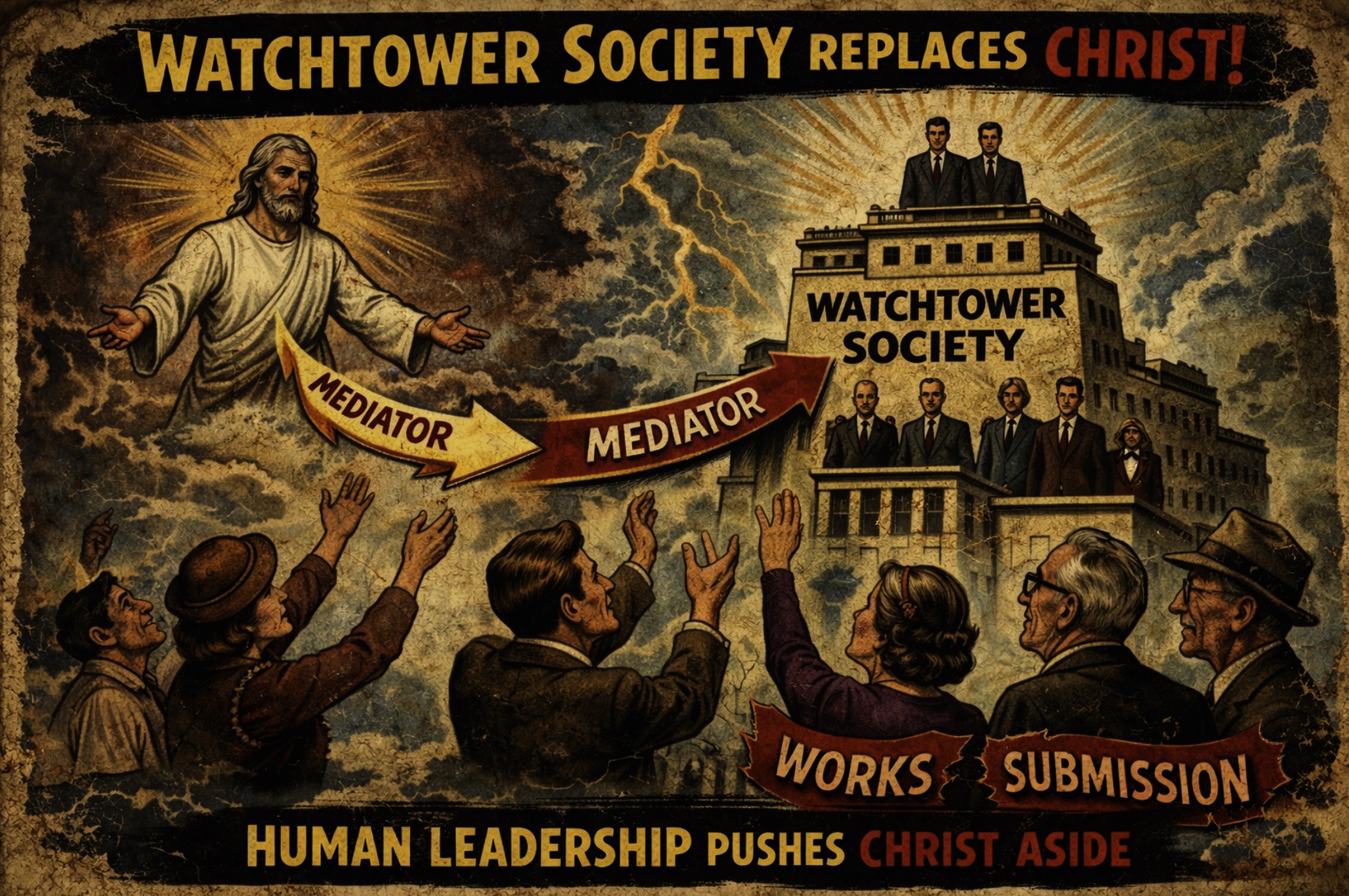


Statements and teachings emphasizing trust in and  obedience to the organization (the “faithful and discreet slave” / Governing Body) place organizational authority ahead of individual judgment or  interpretation of Scripture.


Watchtower-Related Statements Often Cited in This Context

  • I. Emphasis on Trusting Organizational Direction

  • In a 2022 Watchtower study article, it was stated that “we cannot say that we trust in Jehovah if  we do not trust in his earthly representatives — those whom Jehovah trusts.” This was used to  teach that followers should unquestionably trust the organization’s guidance as part of trusting  God.

  • II. Direction Must Come Through the Organization
  • Some Watchtower sources assert that the Bible can only be understood properly through the  organization. For example, “Only this organization … to it alone God’s Sacred Word, the Bible,  is not a sealed book.” Another line states that individuals should “meekly go along with the  Lord’s visible organization” and not rely on personal reasoning.

  • III. Organizational Authority and Obedience

  • Older Watchtower literature included guidance such as “avoid questioning the counsel that is  provided by God’s visible organization,” and loyal elders were admonished not to influence  others to reject spiritual food provided by the “faithful slave.”

  • Official Watchtower Position on Christ’s Headship

  • At the same time, officially Watchtower publications affirm Christ’s headship:  • “The Christ is head of the congregation.” — Watchtower study articles explaining headship  arrangements in the congregation deferred from this position. 
  •  
  • So while one won’t find a statement saying “Christ is below the organization,” some writings emphasize absolute trust/obedience to organizational direction and that Scripture understanding flows through the organization, which critics interpret as functioning in  practice to elevate the organization’s role in members’ spiritual lives.   


    There *are official Watchtower-related publications that emphasize where loyalty and  allegiance should be placed. Below are quotes or paraphrased teachings from Watchtower  sources that highlight allegiance to Jehovah above other things, including family or personal judgment, and emphasize loyalty to the organization as part of that allegiance.

  • Allegiance to Jehovah Through the Organization

    IV. Trust/Obedience to the Organization as Part of Loyalty

  • While Watchtower literature doesn’t explicitly say that the organization is superior to Jesus  Christ, it does teach that trusting and obeying the organization is inseparable from trusting  Jehovah: “…we cannot say that we trust in Jehovah if we do not trust in his earthly representatives.” This teaching insists that loyalty to God includes unquestioning trust in the organization’s  leadership (“earthly representatives”).   This idea is often cited in discussions about how organizational loyalty is framed as part of  loyalty to Jehovah — not as a replacement for Christ, but as essential obedience.

  • V. Watchtower on Belonging to “Jehovah’s Organization”
  • Watchtower publications have presented the organization itself as central to being in Jehovah’s  favor: “To receive everlasting life … we must identify that organization and serve God as part of it.” —  Watchtower 1983 Feb 15 p.12 (quote referenced in commentary on JWFacts).  While this quote is discussed in secondary commentary rather than directly from the Watchtower  Online Library, it indicates how the organization is described in some historical literature.

  • Key Themes in These Teachings

    Theme Watchtower Teaching
    Allegiance to Jehovah must come first, above all — including family.
    God's Organization Trusting Jehovah is tied to trusting the organization’s direction.

    Relations Salvation  

    Requirement


    Discussion exists (in older literature) implying engagement with the  organization is necessary for salvation.

  • Summary

  • 1.Official Watchtower publications robustly teach that loyalty to Jehovah should come  before family or other personal ties.
  • 2. They also frame trust in the organization’s authority as a necessary expression of  obedience to Jehovah. 
  • 3. Some older Watchtower quotations have been interpreted to suggest that being part of  “Jehovah’s organization” is essential for salvation, reinforcing the centrality of  organizational allegiance.

“Jehovah’s organization” (the Watchtower Society and its members) is essential to salvation or  survival of the end times. These are actual published positions or widely referenced doctrinal  points tied to Watchtower theology — some directly from Watchtower publications and some  documented in historical overviews:


Identifying With Jehovah’s Organization Is Essential to Salvation

�� From an older Watchtower publication (often quoted in research discussions):


“Bible students need to get acquainted with the organization of the ‘one flock’ Jesus spoke  about…, They must appreciate that identifying themselves with Jehovah’s organization is  essential to their salvation.” — Kingdom Ministry, November 1990 (as cited in doctrinal overviews).   This explicitly ties the idea of belonging to the organization with being saved.


  • Only Those in the Organization Will Survive the End

  • Historically documented Watchtower quotes (various decades) include:  • “Only Christian witnesses of Jehovah who successfully pass this test will survive…” — The  Watchtower, Sept. 1, 1989.  “If we were to draw away from Jehovah’s organization, there would be no place else to go for  salvation and true joy.”— The Watchtower, Sept. 15, 1993.  • “…survival of individuals today depends on their faith and their loyal association with the  earthly part of Jehovah’s universal organization.” — The Watchtower, May 15, 2006.  • “…Jehovah’s servants already belong to the only organization that will survive the end of this  wicked system of things.”— The Watchtower, Dec. 15, 2007.  
  • These are published over many years, consistently emphasizing survival/end-times hope in the  organization rather than just in Christ alone.


Baptism and Association With the Organization Leads Toward  Salvation

From a recent Watchtower Study article:  “…once you make [your baptism dedication]… you begin a course that leads to everlasting  life… centered on doing God’s will in association with His organization.” — Watchtower Study, February 2026 (symbolizing baptismal dedication as entry into the  organization’s way toward salvation).   This symbolizes that dedication includes joining with the organization as part of the life-course  that Jehovah’s Witnesses view as leading to salvation.   


Organization as the Visible Channel for God’s Salvation

Summary of doctrinal teaching:Jehovah’s Witnesses believe that God uses his visible organization on earth as the only channel  through which people can truly understand the Bible and respond for salvation. This is reflected  in teaching that the Bible must be understood under the guidance of “Jehovah’s visible  organization.”   While this isn’t a verbatim quote, it summarizes a core Watchtower doctrinal stance repeated in  official literature.


What Official Watchtower Publications Say Publicly About Salvation

Importantly, the official current FAQ on jw.org states: “No. Many millions who lived in centuries past and who weren’t Jehovah’s Witnesses will  have an opportunity for salvation.” — jw.org FAQ on salvation, clarifying that not only current Witnesses may have salvation  opportunities.  However, within Watchtower teaching itself, belonging to the organization is still framed as the  normative way for people alive today to show their loyalty to Jehovah God and to position  themselves for salvation, as defined by the Society’s interpretation of Scripture.


Direct Links or Exact Publication Details

“But Jehovah’s servants already belong to the only organization that  will survive…” Publication: The Watchtower Date: December 15, 2007  Quote: “But Jehovah’s servants already belong to the only organization that will survive the end  of this wicked system of things.” This phrasing has been referenced repeatedly in discussions about organizational exclusivity at  the end of the current system.


“If we stop actively supporting Jehovah’s work…” Publication: The Watchtower Date: July 15, 2011  Context: Tied to counsel on active support and loyalty  Documented Equivalent: “…If we stop actively supporting Jehovah’s work, then we start  following Satan. There is no middle ground.” This teaching (often cited in ex-JW forums and summaries) reinforces perception of strong  organizational loyalty as part of spiritual obedience.


“Only Jehovah’s Witnesses … have any Scriptural hope of surviving the  end…”Publication: The Watchtower Date: September 1, 1989  Quote (as documented in secondary source): “Only Jehovah’s Witnesses … as a united  organization … have any Scriptural hope of surviving the impending end of this doomed system  dominated by Satan the Devil.” This wording reflects older doctrinal framing from that time period.


Older Teachings About Obedience to the Organization Publication: The Watchtower (and related materials)  Dates: 1936, 1952, and 1993 materials documented in doctrinal surveys  Quotes (as cited in historical summaries):• “…at Armageddon … saving only those who obey his commandments to stand by his  organization…” — The Watchtower, 1936 (cited in 1993 book Jehovah’s Witnesses— Proclaimers of God’s Kingdom, p.170). • “…Those desiring salvation must make for God’s organization, and find entrance into it  and remain there permanently.” — The Watchtower, October 1, 1952, p.603.   These are older doctrinal statements often referenced in historical critiques.


Important Notes on Interpretation

The official current stance in Watchtower Online Library acknowledges that salvation  and survival ultimately belong to Jehovah’s power and mercy and that many in the past  who weren’t Jehovah’s Witnesses may still have an opportunity in God’s purpose — so  these organizational statements are framed within their doctrinal context.  • The quotes above come from Watchtower publications themselves or from secondary  sites that document them; the exact wording may vary slightly depending on edition.


Jehovah’s Witness publication quotes that explicitly teach  or clearly imply that one cannot benefit from Christ’s ransom sacrifice apart from  association with Jehovah’s organization.

The official current stance in Watchtower Online Library acknowledges that salvation  and survival ultimately belong to Jehovah’s power and mercy and that many in the past  who weren’t Jehovah’s Witnesses may still have an opportunity in God’s purpose — so  these organizational statements are framed within their doctrinal context.  • The quotes above come from Watchtower publications themselves or from secondary  sites that document them; the exact wording may vary slightly depending on edition.


Explicit Statements Linking Christ’s Sacrifice to the  Organization

1. Salvation requires coming into God’s organization
“Those desiring life in the New Order must come into Jehovah’s organization.” — The Watchtower, November 15, 1981, p. 21  This statement directly conditions life (i.e., salvation benefits of Christ’s sacrifice) on entering the  organization.


2. Salvation tied to obedience to God’s organization
“At Armageddon, Jehovah will destroy all those who are not obedient to his organization.” — The Watchtower, September 15, 1983, p. 12  Since Armageddon survival is the Watchtower’s definition of benefiting from Christ’s ransom,  this places the benefit inside organizational obedience.


3. Christ’s ransom applied only through the organization
“Only those who come into Jehovah’s organization will be preserved through Armageddon  into God’s new world.” — The Watchtower, September 1, 1989, p. 19 Here, preservation (salvation) is explicitly limited to organizational association.


4. Faith in Christ insufficient without organizational alignment
“It is not enough to believe in Jesus Christ. One must also identify and associate with  Jehovah’s organization.” — The Watchtower, April 1, 1979, p. 31  This statement directly separates belief in Christ from receiving salvation, making  organizational identification a second, required condition.


5. Christ’s sacrifice benefits only those inside the organization
“Survival of individuals today depends on their faith and their loyal association with the  earthly part of Jehovah’s universal organization.” — The Watchtower, May 15, 2006, p. 22  Although Christ’s sacrifice is not named in this sentence, survival is Watchtower shorthand for  benefiting from the ransom.


6. Leaving the organization forfeits salvation
“If we leave Jehovah’s organization, we leave Jehovah and his provision for life.” — The Watchtower, August 15, 1981, p. 28  Jehovah’s “provision for life” in Watchtower theology is Christ’s ransom—making departure  equivalent to forfeiting its benefits.


7. Only one channel for Christ’s benefits
“Jehovah God has provided a visible organization through which he dispenses spiritual  food and directs his people to salvation.” — The Watchtower, October 1, 1967, p. 591  This frames salvation (and thus Christ’s sacrifice) as something dispensed through the  organization, not directly through Christ alone.


8. No salvation outside the organization
“There is no salvation outside Jehovah’s organization.” — The Watchtower, September 1, 1958, p. 529 This is one of the most explicit early statements equating salvation exclusively with  organizational membership.


Summary Statement (Documentable from Watchtower  Sources) 

While Watchtower publications state that Christ died for all mankind, they also teach— repeatedly and explicitly—that the benefits of Christ’s sacrifice are accessible only through  identification with, obedience to, and continued association with Jehovah’s organization. 

This creates a two-step soteriology: 

1. Christ provides the ransom 

2. The organization controls access to its benefits

1) What Changed After 1917 (Big Picture)
1917 marks a doctrinal turning point following the death of Charles Taze Russell (Oct. 31,  1916) and the rise of Joseph Franklin Rutherford as president of the Watch Tower Bible and  Tract Society. Before 1917 (Russell era): Christ was the sole Head of the Church, there was no salvific organization, all congregations were independent, all association was voluntary, and salvation came through Christ alone. After 1917 (Rutherford era), authority became centralized, Jehovah's organization became God's exclusive channel, organizational obedience became tied to salvation,and dissenters are expelled. Christ’s ransom is framed as administered through the organization.


2) Russell’s Explicit Rejection of Organizational Salvation  (Pre-1917)
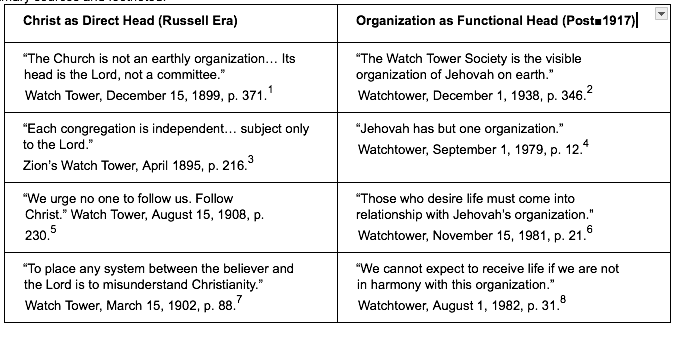
Russell repeatedly denied that any earthly organization mediated salvation. Russell’s Core Positions (with representative quotations) Christ alone is Head, “There is no authority between the Lord and his people.”  — Watch Tower, April 15, 1895, No clerical or organizational control, “The Scriptures recognize no such thing as an earthly organization of the Church.”  — Watch Tower, December 1, 1906, Salvation not tied to membership, “Membership in any earthly organization is not essential to salvation.”  — Watch Tower, July 15, 1895, Voluntary fellowship only, “We advise no bonds, no vows, no oaths—leave all free.”  — Watch Tower, September 15, 1905, Christ died for all—independent of institutions, “The merit of Christ’s sacrifice is for the whole world, quite apart from sects or parties.”  — Studies in the Scriptures, Vol. 1, Bottom line (Russell): Christ’s ransom operates directly between Christ and the believer.  No organization stands between. 


3) Immediate Post-1917 Shift Under
Rutherford centralized power (1917–1919). He did this by the dissolution of Russell's editorial committee, by removing independent directors, by use of corporate authority to enforce compliance, and by equating dissent with disloyalty. This set the structural foundation for doctrinal change.  


4) Doctrinal Intensification Timeline (1919–2007)
1) From 1919 through the 1930s, the organization is introduced as “Ark of Salvation.” “The Lord has an organization… outside of w hich there is no salvation.”  — The Watchtower, 1922. “At Armageddon… saving only those who obey his commandments to stand by his  organization.”  — The Watchtower, 1936 Then the shift comes mainly that Christ’s ransom is accessed via the organization. 
2) During the 1950s, it is taught explicitly that there is “No Salvation Outside the Organization.” “Those desiring salvation must make for God’s organization.”  — The Watchtower, October 1, 1952, p. 603. “There is no salvation outside Jehovah’s organization.”  — The Watchtower, September 1, 1958, p. 529  Shift is to Organizational membership is a salvific necessity. 3) During the 1980s and 1990s: obedience becomes framed as a Survival Requirement. “Those desiring life in the New Order must come into Jehovah’s organization.”  — The Watchtower, November 15, 1981, p. 21 “Only Jehovah’s Witnesses… have any Scriptural hope of surviving…”  — The Watchtower, September 1, 1989,  The shift is to Christ’s ransom benefits are narrowed to organizational loyalty. 4) From the 2000s to the Present, “Loyal Association” Language was developed. “Survival of individuals today depends on… loyal association with the organization.”  — The Watchtower, May 15, 2006, p. 22 “The only organization that will survive the end of this system.”  — The Watchtower, December 15, 2007. The shift is to the doctrine of only the organization is the surviving entity and only people associated with it will survive.  

Why This Matters Theologically

Russell taught Christ-centered soteriology.  Rutherford introduced organization-centered soteriology. In effect, Pastor Russell wrote  Christ died for all; faith unites you to Him. Rutherford changed Christ's died for all , to the organization decides who benefits from the ransom. This is not a minor adjustment—it is a structural replacement:  Christ’s direct headship is changed to Organizational mediation.


Christ’s Headship vs. Organizational Authority A Primary■Source, Side■by■Side Documentary

This document presents a side■by■side comparison of early Bible Student teachings and later Watch Tower statements, showing how functional authority shifted from Christ to the organization. All quotations are taken from primary sources and footnoted. 

Footnotes


Jesus’ Statements That Contradict the  Watchtower Position

1. Jesus as the Sole Mediator — no intermediary  organization “I am the way, and the truth, and the life. No one comes to  the Father except through me.” — John 14:6  


Contradiction: The Watchtower teaches that one must come through  Jehovah’s organization to receive life.  Jesus says He alone is the way—no secondary channel.  


2. Coming to Jesus directly, not to an institution “Come to me, all you who are toiling and loaded down, and I  will refresh you.”  — Matthew 11:28  


Contradiction: Jesus does not say “come to an organization,” elders, or a  governing body.  Jesus' invitation is personal and direct.


3. Eternal life based on faith in Him—not  organizational loyalty “Whoever believes in the Son has everlasting life.” — John 3:36  


Contradiction: Watchtower adds conditions: organizational association,  obedience, survival through Armageddon.  Jesus states belief in Him is the basis of life.


4. Jesus guarantees salvation without institutional mediation. “Truly, truly, I say to you, the one who believes has  everlasting life.”  — John 6:47  


Contradiction: No mention of belonging to a group, surviving an end-times  event, or following an organization.


5. Life depends on relationship with Jesus, not  membership,  “I am the resurrection and the life. The one who believes in  me, even though he dies, will live.”  — John 11:25  


Contradiction: Life is tied to belief in Jesus, not loyalty to an institution.


6. Jesus rejects centralized religious authority “You are all brothers. And do not call anyone your leader, for  one is your Leader, the Christ.”  — Matthew 23:8–10  


Contradiction: The Watchtower teaches obedience to a central governing authority. Jesus forbids replacing Him with human leadership.


7. Belonging to Jesus—not an organization—defines  His people “My sheep listen to my voice… and they follow me. I give  them everlasting life.”  — John 10:27–28  


Contradiction: Jesus’ sheep recognize His voice, not an institutional voice.


8. Salvation does not depend on institutional  allegiance “Everyone who sees the Son and believes in him will have  everlasting life.”  — John 6:40  


Contradiction: The Watchtower teaches salvation depends on remaining in Jehovah’s organization.  Jesus says seeing and believing in Him is sufficient.


9. Jesus condemns systems that block access to God “You shut up the Kingdom of the heavens before men; for  you neither go in yourselves nor allow those on their way in  to go in.”  — Matthew 23:13  


Contradiction: This rebukes religious systems that place themselves between  God and people—precisely what organizational mediation does.


10. No institutional “ark” — salvation is personal “Whoever comes to me I will never drive away.” — John 6:37


Contradiction: No requirement of organizational membership, baptismal vows to  an institution, or loyalty oaths.


The Core Conflict 

Jesus teaches direct access: Christ → believer → life The Watchtower teaches mediated access: Christ → organization → believer → life  These two models are theologically incompatible.


JEHOVAH’S Statements That Contradict  Organizational Mediation

1. Jehovah invites individuals to come directly to Him “Come now, and let us reason together,” says Jehovah.  “Though your sins are like scarlet, they will be as white as  snow.” — Isaiah 1:18


ContradictionJehovah does not say “come to my organization.” He invites direct personal reconciliation.
2. Jehovah rejects intermediaries who replace Him “I am Jehovah, and there is no one else. Besides me there is  no savior.”  — Isaiah 43:11


ContradictionNo organization, channel, or institution is permitted to function as  a savior.


3. Jehovah alone provides life and salvation “It is I—I am the One who blots out your transgressions for  my own sake.”  — Isaiah 43:25


ContradictionForgiveness comes from Jehovah directly, not through  membership or affiliation.


4. Jehovah condemns trust in human systems “Cursed is the man who trusts in mere humans… whose  heart turns away from Jehovah.”  — Jeremiah 17:5


ContradictionTrust placed in human leadership or institutions is explicitly  condemned.


5. Jehovah promises a direct relationship with His  people “They will no longer teach each one his neighbor… saying,  ‘Know Jehovah,’ for they will all know me.”  — Jeremiah 31:34


ContradictionNo permanent teaching class or governing authority stands  between Jehovah and His people.


6. Jehovah desires loyalty, not institutional control “I desire loyalty, not sacrifice, and knowledge of God rather  than burnt offerings.”  — Hosea 6:6


ContradictionJehovah values relationship, not ritual obedience or  organizational allegiance.


7. Jehovah judges individuals—not organizations “The soul who sins is the one who will die… The  righteousness of the righteous will be upon him.” — Ezekiel 18:20


ContradictionSalvation is individual, not collective through an institution.


8. Jehovah promises life to those who seek Him  personally “Seek me and live.”  — Amos 5:4


ContradictionJehovah does not say “seek my organization and live.”


9. Jehovah rejects centralized religious control “Do not put your trust in princes nor in a son of man, who  cannot bring salvation.”  — Psalm 146:3


ContradictionHuman rulers—religious or otherwise—cannot mediate salvation.


10. Jehovah claims exclusive authority over worship  and truth “I am Jehovah. That is my name; I give my glory to no one  else.”  — Isaiah 42:8


Contradiction: Any system claiming exclusive divine authority competes with  Jehovah’s glory.


The Unified Testimony • Jehovah: Come to Me. • Jesus: Come to Me. 

• Watchtower: Come to the organization. 

Jehovah and Jesus speak with one voice—direct, personal,  unmediated access to God.


Scripture Consistently Presents Christ—not an  organization—As The Center Of God’s Plan Of Salvation

1. God’s Plan Is Centered on One Person, Not a  System, “You will call his name Jesus, for he will save his people  from their sins.” — Matthew 1:21  God’s saving purpose is focused on Jesus Himself, not a  structure built around Him.


2. The Hebrew Scriptures Point Forward to Christ through the Promise to Abraham. “In your seed all the nations of the earth will be blessed.” — Genesis 22:18. The apostle Paul explains: “Now the promises were spoken to Abraham and to his  seed… who is Christ.” — Galatians 3:16. God’s salvation plan was never corporate first; it was  Messianic first. Salvation is through The Suffering Servant. “He was pierced for our transgressions… Jehovah caused  the error of us all to meet up with him.” — Isaiah 53:5–6. Salvation is accomplished by one individual, bearing sin  personally. 


3. Jesus Explicitly Declares Himself the Center, the Exclusive Way to God. “I am the way, the truth, and the life. No one comes to the  Fatherexcept through me.” — John 14:6  Not: through a people, through an organization, or through appointed representatives. Jesus alone is the Bread of Life. “I am the bread of life… whoever comes to me will never  hunger.” — John 6:35 Life flows from Christ directly, not through intermediaries. Jesus' life was given for the World “The bread that I will give is my flesh in behalf of the life of  the world.” — John 6:51. Christ’s sacrifice is global in scope, not limited by institutional  boundaries. 

4. The Apostles Confirm Christ Alone Is the Center, no Other Name brings salvation. “There is no salvation in anyone else, for there is no other  name under heaven… by which we must be saved.” — Acts 4:12. There is no mention of a governing body,  an organization, or  a religious system. There is only one Mediator. “There is one God, and one mediator between God and men,  a man, Christ Jesus.” — 1 Timothy 2:5  A mediator by definition excludes additional channels. Salvation is Located “ in Christ” “By this will we have been sanctified through the offering of  the body of Jesus Christ once for all time.” — Hebrews 10:10. “There is now no condemnation for those who are in Christ  Jesus.” — Romans 8:1. Salvation is repeatedly described as relational (“in Christ”), not  institutional. 
5. Christ Is the Head—Nothing Else. Christ is the Head of the Body. “He the head of the body, the congregation… that he might  become the one who is first in all things.” — Colossians 1:18 Christ is not head through an organization. He is directly head. All Fulness Dwells in Him. “It pleased God to have all fullness dwell in him, and through  him to reconcile all things to himself.” — Colossians 1:19–20  Nothing salvific exists outside of Christ that must be accessed  elsewhere.


6. Faith Is Placed in Christ—Not Structures. “Everyone who believes in him receives forgiveness of sins  through his name.” — Acts 10:43. “Believe in the Lord Jesus, and you will be saved.” — Acts 16:31. The apostles never added you must “remain in the organization,” “submit to central authority” or “be in the only surviving group”


7. The Final Testimony of Scripture, Christ Is the Object of Faith. “These things are written so that you may believe that Jesus  is the Christ… and because of believing, you may have life  by means of his name.”  — John 20:31 

Bottom Line (Scripturally) God’s plan of salvation is not: God → Christ → organization → people 

It is: God → Christ → people 

Anything added after Christ changes the biblical model.