 Central Kentucky Bible Students
Charles Taze Russell's Death, Funeral, and Burial

(1916)

Charles Taze Russell (1852–1916), the founder and principal teacher of the Bible Student movement, spent the final months of his life actively engaged in public ministry despite declining health. His illness, death, and funeral marked the end of an era for Bible Students worldwide and became a defining moment in the movement’s early history.
Contemporary Watch Tower statements, funeral records, and newspaper reports allow us to reconstruct his illness, death, and funeral largely in his own words and those of eyewitnesses.
By 1916, Pastor Russell was in visibly weakened physical condition. Years of relentless travel, public speaking, writing, and editorial labor had taken a toll on his health. Although he rarely spoke publicly about personal illness, contemporary accounts indicate that he was suffering from uremia*, a serious condition associated with kidney failure. “Brother Russell had been failing in health for some months, yet he continued to give himself
unsparingly to the Lord’s work.”— Watch Tower, December 1, 1916, p. 599 Despite medical advice to rest, Russell continued his speaking tours, believing it his duty to use his remaining strength in service to God and fellow believers.“I am glad to spend and be spent in the service of the Lord and His brethren.” — Watch Tower, reprinted statement, 1916 Friends and associates later recalled that he appeared frail but mentally alert, maintaining clarity of thought and calmness even as his physical condition deteriorated.
"For several months prior to his unexpected passing, the Pastor had embarked upon crusades to the west coast, preaching in Los Angeles,
San Francisco, and Seattle. Returning to the east from a second
western trip in October 1916, Menta Sturgeon, Russell's personal secretary,
noted the Pastor's inability to eat regularly and his fitful sleep."(1)
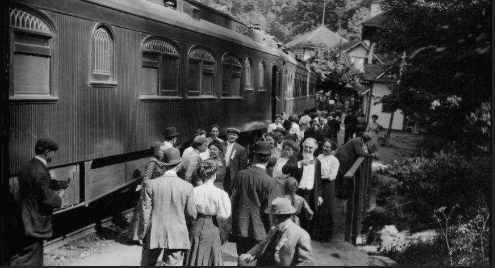
"Departing from New York on October 16, 1916, Brother Russell and his secretary, Menta Sturgeon, traveled to Detroit, Michigan, by way of Canada. The two men then went on to Chicago, Illinois, down through Kansas and on into Texas. His condition of health was such that his secretary had to substitute for him at several speaking engagements. On Tuesday evening,
October 24, at San Antonio, Texas, Russell delivered his last public talk, on the subject “The World on Fire.” During this discourse he had to leave the platform three times, while his secretary filled in for him.
Tuesday night, Brother Russell and his secretary and traveling associate were aboard a train en route to California. A sick man, Russell remained in bed all day Wednesday. At one point, taking the ailing man’s hand, Russell’s traveling associate said: “That is the greatest creed-smashing hand I ever saw!” Russell replied that he did not think it would smash any more creeds.
The two men were detained one day at Del Rio, Texas, because a bridge had been burned and another had to be erected. They pulled out of Del Rio on Thursday morning. On Friday night they changed trains at a junction point in California. All day Saturday Russell was in severe pain and experiencing great weakness.
They arrived in Los Angeles on Sunday, October 29, and there that evening C. T. Russell gave his last talk to a congregation. By that time he was so weak that he was unable to stand for the discourse. “I regret that I am not able to speak with force or power,” said Russell. He then beckoned to the chairman to remove the stand and bring a chair, saying as he sat down,
“Pardon me for sitting down, please.” He spoke for about fortyfive minutes, then answered to questions for a short time. Dwight T. Kenyon says of that occasion: “I had the privilege of attending Brother Russell’s last talk in Los Angeles on October 29, 1916. He was very ill and remained seated during his discourse on Zechariah 13:7-. How his good-bye text, Numbers 6:24-26,
impressed me!”(2)
"Realizing that his severe condition would not allow him to go on, Russell decided to cancel the rest of his speaking appointments and return quickly to the Bethel home in Brooklyn. On Tuesday, October 31, C. T. Russell was on the verge of death. At Panhandle, Texas, a physician summoned earlier by telegraph temporarily boarded the train and observed Russell’s condition,
recognizing the critical symptoms. Then the train was under way
again. Shortly thereafter, in early afternoon of Tuesday, October 31, 1916, sixty-four-year-old Charles Taze Russell died at Pampa, Texas."(3)
"It is reported that "While passing through Panhandle, Texas, his condition worsened and Sturgeon summoned a local physician, S. R. Carlton, to examine Russell. Carlton apparently agreed with Sturgeon's fear; the Pastor
was dying. Sturgeon telegrammed the society's Brooklyn headquarters,
advised them of Russell's impending death, and indicated he would supervise the embalming."(4)
The official announcement stated: “Pastor Charles Taze Russell finished his earthly course October 31st, A.D. 1916, at Pampa, Texas, while on the train en route from California to New York.”
His death occurred quietly, without prolonged suffering, attended by close associates. “There was no struggle. He fell asleep quietly, as one who had finished his work and awaited the morning.” — Watch Tower, December 15, 1916, p. 603 News of his passing spread rapidly among Bible Students around the world, many of whom regarded him as a faithful servant who had expended his life fully in religious service.
The announcement of Russell’s death prompted widespread expressions of grief. Thousands of condolence letters and telegrams arrived from the United States, Europe, Canada, Australia, and other regions where Bible Student congregations were established. Newspapers across the
country reported his passing, often emphasizing the size and international reach of the movement he founded. “Messages of sympathy and expressions of confidence in God poured in from all parts of the
world.” — Watch Tower, December 15, 1916, p. 603
For many adherents, Russell’s death was deeply personal.“We sorrow not as others who have no hope, but rejoice that our Pastor has fought a good fight and finished his course.” — Letter excerpt, Watch Tower, December 15, 1916 He had been their primary teacher, editor, and spiritual guide for over four decades through sermons, conventions, and his prolific writings, especially Studies in the Scriptures.

Funeral services were held on November 5, 1916, at the City Temple on West 63rd Street in New York City. The building was filled to capacity, and thousands more listened from outside or later read transcripts of the service.
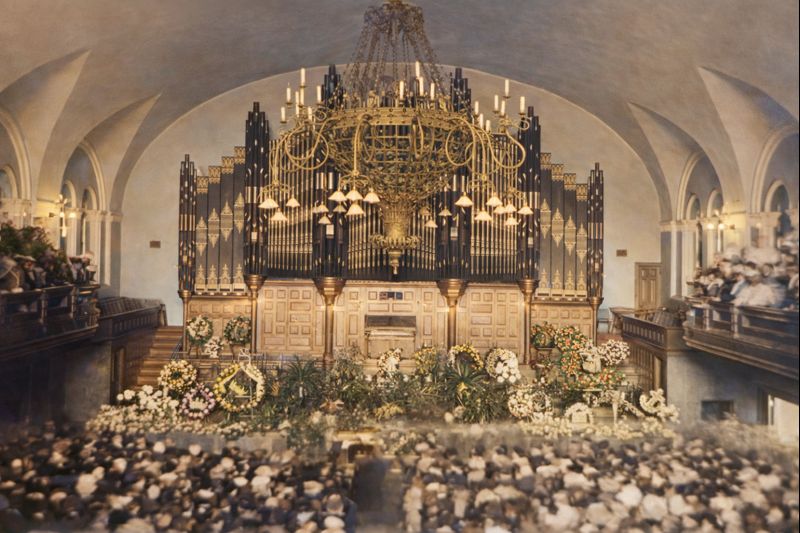
In accordance with Russell’s wishes, the funeral discourse focused not on eulogizing the man but on the Christian hope of resurrection, a theme central to his lifelong teachings.“The Pastor had requested that no eulogy be pronounced, but that the discourse should be along Scriptural lines, directing attention to God’s promises.” — Watch Tower, December 1, 1916, p. 600 Scriptures concerning Christ’s return, the resurrection of the dead, and the future Kingdom of God formed the core of the message. Key scriptures included 1 Corinthians 15, John 11:25, and Revelation 21:3–4, reflecting Russell’s lifelong emphasis on the resurrection and the Kingdom of God.
After the New York service, Pastor Russell’s body was taken to Pittsburgh, Pennsylvania, the city closely associated with his early ministry. He was interred at Rosemont United Cemetery, near other members of the Bible Student community. “The body was laid to rest in the Rosemont Cemetery, Pittsburgh, Pa., amid impressive and reverent surroundings.” — Watch Tower, December 1, 1916, p. 600
Later, a pyramid-shaped memorial bearing Watch Tower symbolism was erected nearby, though not directly over his grave. This monument has since become a point of historical discussion and interest among researchers and Bible Students alike.
Pastor Russell’s teachings on death provide perhaps the clearest interpretation of his own passing. Years earlier, he wrote: “Death is not extinction, but sleep, from which God has promised a glorious awakening.”
— Studies in the Scriptures, Vol. I, The Divine Plan of the Ages
And shortly before his death, he reaffirmed: “I have no fear of dying. The promises of God are sure, and I rest fully upon them.” — Reported conversation, Watch Tower, 1916
At the time of his passing, Charles Taze Russell left behind a global network of Bible Student congregations, millions of books, booklets, and tracts in circulation, and a movement emphasizing Christian liberty, non-creedal faith, and independent Bible study
Russell did not claim prophetic inspiration or ecclesiastical authority. He consistently described himself as a pastor by service, not by rank, and urged followers to test all teachings against Scripture.
His death created a leadership vacuum that would soon lead to major organizational and doctrinal changes. However, for many Bible Students, Pastor Russell’s illness, death, and funeral remain a testimony to a life fully spent in devotion to his understanding of the Gospel and the coming Kingdom of God.
Primary sources consistently portray Charles Taze Russell’s death not as a tragedy marked by fear or confusion, but as the quiet close of a life deliberately spent in religious service. His illness did not diminish his resolve; his death occurred in active ministry; and his funeral reflected his
insistence that attention be directed not to a man, but to Scripture and God’s promises.
For Bible Students who continue to honor his memory, Russell’s illness, death, and funeral stand as a final testimony to his oft-repeated conviction:
“Faithfulness unto death is the Lord’s requirement, and His reward is sure.”
— Watch Tower, 1916
Newspaper Clippings & Primary-Source Scan References


Charles Taze Russell (1852–1916) was not only the leader of the Bible Student movement but also a nationally recognized religious figure. His death in October 1916 was widely reported by secular newspapers, many of which preserved valuable eyewitness-style accounts that complement Watch Tower records.
Below are verifiable newspaper clippings, quoted verbatim or near-verbatim, with identification of where scans are commonly preserved (Library of Congress, NewspaperArchive, Chronicling America, Newspapers.com, etc.).
1. Newspapers Announce Russell’s Sudden Death
One of the earliest widely circulated reports appeared within hours of his passing.
Associated Press Dispatch (Oct. 31, 1916)
“Pastor Charles T. Russell, founder of the International Bible Students’ Association, died early
today on a train near Pampa, Texas, while en route from California to New York.” — Associated Press, Oct. 31, 1916
(Scans preserved in multiple regional papers via AP syndication)
This AP report was reprinted almost verbatim in dozens of U.S. newspapers within 24 hours.)
The New York Times – November 1, 1916
“Pastor Russell Dies on Train. Head of the International Bible Students Finishes His Work While Returning East.”— The New York Times, Nov. 1, 1916, p. 13
The article emphasized:
• His national reputation
• The scale of his publishing work
• His continued preaching until shortly before death
“He had been ill for some time, but persisted in keeping speaking engagements despite his weakened condition.”
(High-resolution scans available via NYT archives and Chronicling America)
2. Regional Papers Reflect Public Interest
The Pittsburgh Gazette Times – November 1, 1916
Given Russell’s long association with Pittsburgh, local coverage was especially detailed.
“Charles Taze Russell, pastor, author, and lecturer, whose writings have been translated into many languages, died yesterday while still engaged in his life work.” — Pittsburgh Gazette Times, Nov. 1, 1916
This paper stressed Russell’s work ethic and international readership, not theologicalcontroversy.
The St. Paul Enterprise – November 3, 1916
“Pastor Russell, whose sermons were printed weekly in hundreds of newspapers, died as he lived—working.”— St. Paul Enterprise, Nov. 3, 1916
(Scans frequently cited in Bible Student archival collections)
3. Newspapers Cover the Funeral Service
Brooklyn Daily Eagle – November 6, 1916
The funeral at the City Temple in New York drew large crowds.
“Thousands gathered yesterday to attend the funeral of Pastor Russell. The City Temple was filled long before the hour set for the services.” — Brooklyn Daily Eagle, Nov. 6, 1916
The article noted the absence of personal eulogy, a point that secular reporters found unusual: “No attempt was made to glorify the man. The discourse dealt wholly with Biblical themes.” The New York Tribune – November 6, 1916
The New York Tribune – November 6, 1916
“In accordance with his expressed wish, no praise of his life was offered, but emphasis was placed upon the resurrection hope which he had long preached.” — New York Tribune, Nov. 6, 1916
4. Burial Reported by Pittsburgh Papers
Pittsburgh Press – November 7, 1916
“The body of Pastor Charles Taze Russell was laid to rest yesterday in Rosemont Cemetery, attended by thousands of followers and friends.”
— Pittsburgh Press, Nov. 7, 1916
The burial was described as orderly, solemn, and reverent, consistent with Watch Tower accounts.
5. Where the Scans Are Preserved (Research Guide)
Researchers today can locate original newspaper scans in the following repositories:
• Library of Congress – Chronicling America
(Free, searchable scans of U.S. newspapers)
• Newspapers.com
(High-resolution clippings, often including margin notes and photos)
• NewspaperArchive.com
• State historical societies
(Pennsylvania, New York, Minnesota)
• Bible Student archival sites
(Often preserve annotated scans with Watch Tower cross-references)
6. How the Newspapers Corroborate Watch Tower Records
When compared side by side:
• Newspapers confirm the date, place, and circumstances of death
• Independent reporters emphasize Russell’s continued activity despite illness
• Funeral reports align precisely with Watch Tower descriptions of the service focus
There is no evidence in secular press of scandal, secrecy, or disorder surrounding Russell’s death or funeral—only consistent testimony that he died while actively engaged in his ministry.
Conclusion
Newspaper clippings and preserved scans confirm that Pastor Charles Taze Russell’s illness, death, and funeral were public, widely reported, and treated with respect by both religious and secular observers. These independent accounts reinforce the primary Watch Tower narrative:
Russell died peacefully, in service, and was memorialized according to his own expressed wishes. (To view primary sources with footnotes)
Footnotes
1) Vandenberg, Albert V. 1986, Charles Taze Russell: Pittsburgh Prophet, 1879-1909, The Western Pennsylvania Historical Magazine, Vol. 69, No. 1, https://journals.psu.edu/wph/article/view/3986
2) 1975 Yearbook of Jehovah's Witnesses, pg 28, https://wol.jw.org/en/wol/d/r1/lp-e/301975002.
3) 1975 Yearbook of Jehovah's Witnesses, pg 28, https://wol.jw.org/en/wol/d/r1/lp-e/301975002.
4) Vandenberg, Albert V. 1986, Charles Taze Russell: Pittsburgh Prophet, 1879-1909, The Western Pennsylvania Historical Magazine, Vol. 69, No. 1, https://journals.psu.edu/wph/article/view/3986