 Central Kentucky Bible Students

Jehovah’s Witnesses
A Historical and Doctrinal Analysis
Prepared for Central Kentucky Bible Students

Jehovah’s Witnesses
This paper demonstrates that Charles Taze Russell (1852–1916) was not the founder of the religious organization known as Jehovah’s Witnesses. Using primary Watch Tower sources, organizational history, and doctrinal comparison, the study shows that Jehovah’s Witnesses emerged as a distinct movement after Russell’s death through structural and theological changes introduced under Joseph F. Rutherford.
Russell founded and led the Bible Student movement, a non-denominational fellowship characterized by local autonomy, absence of centralized authority, and freedom of conscience. The Watch Tower Society functioned as a publishing agency rather than a governing body.
The Pastor wrote “We have no organization in the sense of a hierarchy… The Bible Students are free.” ("Stand fast, therefore, in the liberty wherewith Christ hath made us free, and be not entangled again with the yoke of bondage." Gal. 5:1)
Pastor Charles Taze Russell consistently opposed centralized religious organization. He envisioned the Bible Students as a non-denominational fellowship united by faith, love, and devotion to Christ rather than creeds or institutional authority.
1. Rejection of an Earthly Organization
“We have no organization that binds us together except the ties of love and truth.” — Zion’s Watch Tower, Sept. 15, 1895, p. 216
Biblical Proof
And beyond all these, put on love, which is the bond of perfect unity. Col. 3:15
It is for freedom that Christ has set us free. Stand firm, then, and do not let yourselves be burdened again by a yoke of slavery. Gal.5:1
He has lost connection to the head, from whom the whole body, supported and knit together by its joints and ligaments, grows as God causes it to grow. If you have died with Christ to the spiritual forces of the world, why, as though you still belonged to the world, do you submit to its regulations:“Do not handle, do not taste, do not touch!”? These will all perish with use, because they are based on human commands and teachings. Such restrictions indeed have an appearance of wisdom, with their self-prescribed worship, their false humility, and their harsh treatment of the body; but they are of no value against the indulgence of the flesh. Col. 2:19-23

2. Opposition to Clergy and Ecclesiastical Hierarchy
“The Bible Students have no earthly organization. They are not bound together by creeds or rules, but by the one hope, the one Lord, and the one faith.” — Zion’s Watch Tower, April 15, 1907, p. 117.
Biblical Proof
and with diligence to preserve the unity of the Spirit through the bond of peace. There is one body and one Spirit, just as you were called to one hope when you were called; one Lord, one faith, one baptism; ... Ep 4:3-6
The body is a unit, though it is composed of many parts. And although its parts are many, they all form one body. So it is with Christ. / For in one Spirit we were all baptized into one body, whether Jews or Greeks, slave or free, and we were all given one Spirit to drink. 1 Corn 12:12-14
3. Organizational Control as Spiritual Bondage
“The moment any religious body begins to organize itself beyond the local congregation, that moment it begins to go into bondage.” — Zion’s Watch Tower, June 15, 1910, p. 185.
Biblical Proof
I am afraid, however, that just as Eve was deceived by the serpent’s cunning, your minds may be led astray from your simple and pure devotion to Christ. 1 Corn. 11:3
And this occurred because of false brethren secretly brought in (who came in by stealth to spy out our liberty which we have in Christ Jesus, that they might bring us into bondage), Gal. 2:4
Now the Lord is the Spirit, and where the Spirit of the Lord is, there is freedom. 2 Corn 3:17
4. Autonomy of the Local Congregation
“Each Ecclesia is separate and independent, subject to no control from any other Ecclesia or from any outside authority.”
— Zion’s Watch Tower, Oct. 15, 1909, p. 298.
Biblical Proof
Paul and Barnabas also appointed elders in every church. With prayer and fasting, they turned the elders over to the care of the Lord, in whom they had put their trust. Acts 14:23
Therefore, brothers, select from among you seven men confirmed to be full of the Spirit and wisdom. We will assign this responsibility to them and will devote ourselves to prayer and to the ministry of the word. This proposal pleased the whole group. They chose Stephen, a man full of faith and of the Holy Spirit, as well as Philip, Prochorus, Nicanor, Timon, Parmenas, and Nicolas from Antioch, a convert to Judaism.b They presented these seven to the apostles, who prayed and laid their hands on them. Acts 6:3-6
And the things that you have heard me say among many witnesses, entrust these to faithful men who will be qualified to teach others as well. 2 Tim.2:2
5. Rejection of Rules and Creeds
“To attempt to make rules and regulations for the Church is to do what the Lord never authorized.” — Zion’s Watch Tower, Aug. 15, 1908, p. 235.
Biblical Proof
Not that we lord it over your faith, but we are fellow workers with you for your joy, because it is by faith that you stand firm. 2 Corn 1:24
6. Warnings Concerning Future Leaders
“Beware of any man or system that would attempt to take control of your faith.” — Watch Tower Reprints, R5527 (1914).
Biblical Proof
Christ alone is Head of the Church. Eph 1:22-23 Col. 1:18
But you are not to be called ‘Rabbi,’ for you have one Teacher, and you are all brothers. And do not call anyone on earth ‘father,’ for you have one Father, and he is in heaven. Nor are you to be called instructors, for you have one Instructor, the Messiah. Matthew 23:8-10
And he is the head of the body, the church; he is the beginning and the firstborn from among the dead, so that in everything he might have the supremacy. Col. 1:18
(Elders) not lording it over those entrusted to you, but being examples to the flock. 1 Pet. 5:3
7. Opposition to Sectarian Identity
“We are not a sect or denomination… We have no name except ‘Bible Students.’” — Zion’s Watch Tower, Oct. 1, 1910, p. 298.
Biblical Proof
There is only one Lawgiver and Judge, the One who is able to save and destroy. But who are you to judge your neighbor? James 4:12
The acts of the flesh are obvious: sexual immorality, impurity, and debauchery; idolatry, sorcery, enmity, strife, jealousy, fits of anger, rivalries, dissensions, divisions Gal. 5:19-20
First of all, I hear that when you come together as a church, there are divisions among you, and in part I believe it. And indeed, there must be differences among you to show which of you are approved. 1 Corn 11:18-19
8. The Watch Tower Society as a Business Convenience
“The Society is a business convenience, not a church authority.” — Zion’s Watch Tower, Dec. 15, 1916, p. 599.
Pastor Russell consistently taught that centralized organization leads to spiritual bondage. He upheld Christ alone as Head of the Church and emphasized congregational autonomy, freedom of conscience, and
fellowship based on love and truth rather than institutional control.
1916 – Russell’s Final Position
“The Society is a business convenience, not a church authority.” — Watch Tower, Dec. 15, 1916, p.599. “Each Ecclesia is separate and independent.” — Watch Tower, Oct. 15, 1909, p. 298.
Meaning:
No headquarters rule, no centralized authority, no enforced
doctrine.

Following Russell’s death in 1916, Joseph F. Rutherford centralized authority within the Watch Tower Society, eliminated congregational self-rule, and enforced doctrinal conformity. These changes produced a movement fundamentally different from that led by Russell. Rutherford wrote “Jehovah has always had a visible organization, and it is necessary to be in it to receive life.”
1917 – Centralization of Authority
Judge Rutherford said “The President is the executive officer of the Society and has full control of its affairs.” — Watch Tower, Jan. 15, 1917, p. 1 Power shifted from congregational autonomy to corporate presidency control.
Rutherford’s action:“The President is the executive officer of the Society and has full control of its affairs.” — Watch Tower, Jan. 15, 1917, p. 12
1917 – Editorial Committee Removed
Russell established a five-man Editorial Committee in his will to prevent doctrinal control by one man. Russell’s stated purpose for doing this:
• No single man would control doctrine
• No president could rewrite teachings at will, Christ—not an officer—would remain Head of the Church Russell explicitly feared post-mortem centralization.
Judge Rutherford wrote:“The Editorial Committee has ceased to function.” — Watch Tower, June 1, 1917, p. 162. Why?
1. The Committee Limited Rutherford’s Authority
Under Russell’s arrangement:
• The president was administrative, not doctrinal
• Articles required committee approval
• Teaching authority was distributed, not centralized
This structure directly conflicted with Rutherford’s legalistic,
corporate leadership style.
2. Rutherford Wanted Absolute Executive Control
Within months of Russell’s death, Rutherford asserted sweeping
authority: “The President is the executive officer of the Society and has full
control of its affairs.” — Watch Tower, Jan. 15, 1917, p. 12 This claim went far beyond Russell’s practice and could not coexist with an independent doctrinal committee.
3. The Committee Resisted Rutherford’s Direction
Historical record shows that:
• Editorial Committee members objected to Rutherford’s
changes
• They opposed unilateral doctrinal and organizational
revisions
• They cited Russell’s will as binding authority
For Rutherford, the committee was not advisory—it was an
obstacle.
4. Rutherford Declared the Committee Defunct
Rutherford simply announced its end: “The Editorial Committee has ceased to function.” — Watch Tower, June 1, 1917, p. 162. There was no congregational vote, no replacement, no scriptural justification.
This act nullified Russell’s safeguards.
5. Removal Enabled Immediate Doctrinal Changes
Once the committee was gone, Rutherford rapidly introduced:
• Organizational supremacy doctrines
• Loyalty tests to the Society
• Mandatory service requirements
• Elimination of Russell-era teachings and symbols (including
the cross)
The timing is critical: these changes were impossible while the
committee existed.
6. The Elimination Was Part of a Broader Power
Consolidation
The removal of the Editorial Committee coincided with:
• Removal of dissenting directors
• Rewriting of Society bylaws
• Expulsion of opposing Bible Students
• Redefinition of obedience as loyalty to the organization
All required unchecked authority.
7. Early Bible Students Recognized the Move for What It Was
Many Bible Students objected, arguing that:
• Rutherford violated Russell’s will
• Doctrinal authority was being centralized
• Christ’s headship was being replaced by corporate rule
These objections fueled the 1917–1919 schisms
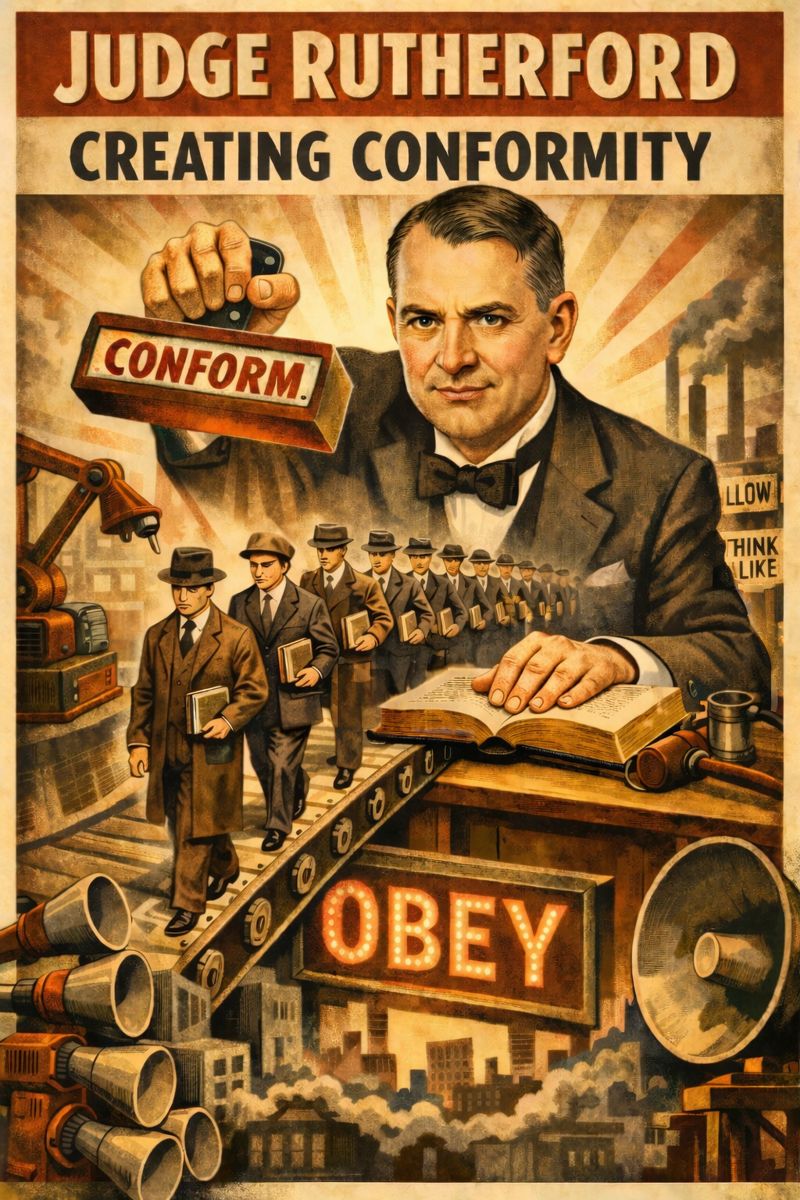
1919 – Organization Declared God’s Channel
Rutherford Replaced Christ’s Headship with the Organization
Pastor Russell taught Christ Alone Is Head of the Church and that no human institution could stand in His place. He wrote: “The Church is not an earthly organization. Christ alone is its Head.” — Watch Tower, Dec. 1, 1908, p. 361. He also warned: “Beware of any man or system that would attempt to take control of your faith.” — Watch Tower Reprints, R5527 (1914). He wrote: “The unity of the Church is not secured by organization, but by
the spirit of the Lord.” — Watch Tower, June 15, 1909, p. 186
Under Russell, the Watch Tower Society was explicitly not a spiritual authority.
Under Judge Rutherford the organization becomes God’s only channel of direction. “God has but one organization, and that organization is the
Watch Tower Bible and Tract Society.” — Watch Tower, Aug. 1, 1919, p. 235
This transfers functional authority from Christ’s invisible headship to a visible institution. Rutherford explicitly taught that unity and salvation depended on obedience to the organization rather than Christ. He wrote:
“Unity can be had only by obedience to the organization.”— Watch Tower, Dec. 15, 1920, p. 375
Obedience once owed to Christ and conscience was now owed to headquarters. The organization took over Christ’s Mediating Role.
Pastor Russell taught that was Christ the sole mediator between God and the church: “There is one Mediator between God and men, the man Christ
Jesus.” — Watch Tower, May 1, 1907, p. 134 Under Rutherford, access to truth and service became organization-mediated: “To receive life one must come into relationship with Jehovah’s organization.” — Watch Tower, Nov. 15, 1931, p. 327. This effectively interposes the organization between
Christ and the believer.
1920 – Obedience to Organization
“Unity can be had only by obedience to the organization.” — Watch Tower, Dec. 15, 1920, p. 375. Judge Rutherford replaced Christ’s Authority with
Corporate Rule. He removed congregational election and placed all
authority in the Society: “All servants are appointed by the Society.”
— Watch Tower, June 1, 1938, p. 164. Pastor Russell, on the other hand,l had written: “The congregation chooses its own servants.”— Watch Tower, May 15, 1906, p. 149 Christ’s guidance through the local body was replaced by topdown corporate appointment. Under Rutherford, loyalty to Christ became inseparable from loyalty to the organization: “Those who abandon the organization abandon Jehovah.” — Watch Tower, Sept. 15, 1934, p. 277
This was expressly against Paster Russell's teaching. He wrote: “To leave a human system does not mean to leave the Lord.” — Watch Tower, July 15, 1897, p. 216. Christ's headship was replaced by the organization: “God has but one organization.” — Watch Tower, Aug. 1, 1919, p. 235. “Jehovah has always had a visible organization, and obedience to it is essential.”
1922 – Mandatory Witnessing
“Advertise, advertise, advertise the King and the Kingdom.” — Cedar Point Convention, 1922. Pastor Russell taught that witnessing Was voluntary, not compulsalury. Christian witnessing arose from personal conviction and
opportunity, not from quotas, enforcement, or centralized directives.
“We are not seeking to force the truth upon anyone… The Lord is not compelling His people to engage in public work beyond their ability or opportunity.” — Watch Tower Bible and Tract Society publications, paraphrased from repeated statements, c. 1890s–1910s. There was no requirement to preach, no reporting of time, placements, or activity.
Certainly there was no disciplinary action for non-participation.
Early Bible Students was urged: “Each must decide for himself what he can do, what he should do, and how he should do it.” Illness, age, work, and family were legitimate reasons not to engage in public activity. Quiet Christian living was considered a valid testimony. Witnessing took many forms, not just Door-to-Door. Acceptable forms included, and are still followed by Bible Students, personal conversation, letter writing, lending books, supporting lectures, finacial support, private study and character development. “Some can serve best in one way, others in another… all service is valuable if rendered unto the Lord.” — Watch Tower principle
No single method was elevated above others. Russell taught that Christlikeness, not activism, was the true mark of a Christian. “The chief mission of the Church in the present time is the perfecting of the saints, not the conversion of the world.” — Studies in the Scriptures, Vol. VI
Judge Rutherford used witnessing to centralize authority. He transformed the loose Bible Student fellowship into a command-and-control
organization under the Watch Tower Bible and Tract Society. Mandatory witnessing created measurable obedience through the counting of hours, placements of magazines and books, and return visits. Compliance was monitored and enforced by headquarters. Authority shifted from local conscience to organizational mandate. Preaching became proof of loyalty.
Those refusing to comply were labeled inactive, unfaithful, or later opposers. Door-to-door witnessing also functioned as legal insulation. Judge Rutherford framed preaching as a religious duty, not voluntary evangelism. This helped defend the organization in U.S. courts on free-exercise grounds. Members acting under orders strengthened claims that literature distribution was
protected worship.
Whereas, Pastor Russell saw witnessing as voluntary, varied, and conscience-based. He emphasized personal study, correspondence, and lectures. No time quotas or enforcement mechanisms existed.However, under Judge Rutherford, public witnessing became the primary Christian obligation. Failure to preach implied spiritual weakness or rebellion. Christianity was redefined as organizational activity.
Mandatory witnessing created powerful internal pressure on members of the organization. Constant activity limited time for independent thinking. Group conformity increased through shared routines. Fear of being labeled inactive discouraged dissent. This transformed members into full-time representatives of the organization, not merely just believers. Judge Rutherford insisted that Armageddon was imminent. Only those actively warning others would survive. Preaching was a life-or-death obligation, not an option. This urgency justified coercion and removed room for personal discretion.
1925 – Failed Prophetic Claim
“Millions now living will never die," was prodicted by Judge Rutherford in 1920. Rutherford promoted multiple date-specific and outcome-specific prophetic claims that failed to materialize. These included the 1925 resurrection of the ancient worthies, the promise that millions then
living would never die, the imminent destruction of world governments, and the immediate establishment of God’s Kingdom on earth. Beth Sarim was constructed in anticipation of resurrected princes who never appeared. Following these failures, teachings were later reframed as expectations
rather than prophecy.
Joseph F. Rutherford did not typically state, 'I am a prophet.' However, he asserted prophetic authority by teaching that God communicated through the organization he led and by presenting his interpretations as divine proclamations rather than human opinions. This functional prophetic role
required acceptance of his authority and discouraged questioning. In contrast, Charles Taze Russell explicitly denied prophetic inspiration and rejected claims of divine authority over others.

1928 – Cross Rejected
“The cross is a pagan symbol.” wrote Judge Rutherford in the Watch Tower, Nov. 15, 1928, p. 339. For Pastor Russell the cross was foundational, not decorative. “The cross of Christ is the great center of Christian doctrine.”
— Watch Tower, April 15, 1898, p. 117. For Bible Students the Cross and Crown symbol represented Christ’s ransom sacrifice, his suffering, and the hope of glory. It appeared on Watch Tower literature, Bibles, pins, and
meeting halls. Eliminating the cross meant breaking continuity with Russell’s teaching and consolidating his control over the organization's followers.
The cross was the most visible reminder of Pastor Russell’s theology.
Claiming the cross was pagan, contradicted decades of Russell’s
published teaching. The idea that the cross was pagan did not originate with Judge Rutherford and was selectively applied. Early Christians used the cross symbolically despite pagan misuse, which Russell had already addressed pagan objections decades earlier. Pastor Russell wrote:
“That pagans misused the symbol does not make the cross un-
Christian.” — Watch Tower, Sept. 15, 1907, p. 275 Judge Rutherford reversed this without new evidence. The Cross represented a Christ-centered faith—Which Judge Rutherford replaced with the organization.
After eliminating the cross, Judge Rutherford rejected all Christian symbols, changed the organizations name, emphasised mandatory witnessing and obedience to the organization. Judge Rutherford feared the cross because it was a symbol of Christ's finished work. It emphazied the equality of believers, that Christ died for all men. It also emphazied that salvation is through Christ and was through the mediation of a man or an organization.
This conflicted with Rutherford’s model, which taught: “To receive life one must come into relationship with Jehovah’s organization.”— Watch Tower, Nov. 15, 1931, p. 327 A cross-centered gospel leaves no role for an institutional mediator. The elimination was sudden, enforced, and
punitive. Cross-and-crown jewelry was condemned. Literature with cross imagery was withdrawn. Those who resisted were labeled disloyal. Many early Bible Students separated at this point due to Judge Rutherford's organizational enforcement.

1931 – Name Change
“We desire to be known as Jehovah’s witnesses.” — Watch Tower, Oct. 15, 1931, p. 308.
The adoption of the name “Jehovah’s Witnesses” in 1931 marked a decisive transformation within the Bible Student movement. Under the leadership of Judge Joseph F. Rutherford, the movement abandoned its earlier identity as the International Bible Students—a loose association of independent
congregations—in favor of a centralized religious organization with a mandatory name, defined authority, and organizational loyalty. This change represented a clear departure from the principles articulated by the movement’s founder, Pastor Charles Taze Russell. During Charles Taze Russell’s lifetime, the term “Bible Students” functioned only as a descriptive
designation rather than an official denominational name. Russell consistently rejected sectarian titles, teaching that Christians already possessed a Scriptural identity and that religious names fostered
division. Congregations were independent, self-governing, and united by shared study rather than organizational allegiance.
Following Russell’s death in 1916, disputes over authority and governance fractured the Bible Student movement. When Rutherford assumed the presidency of the Watch Tower Bible and Tract Society in 1917, many congregations rejected centralized control and separated. By the late 1920s, the movement was divided, prompting efforts to distinguish loyal adherents from dissenters and consolidate authority.
In July 1931, at a convention in Columbus, Ohio, Rutherford promoted a resolution adopting the name “Jehovah’s Witnesses,” based on Isaiah 43:10. The name was presented as divinely directed and quickly became a public marker of loyalty to the central organization. Acceptance of the name
distinguished Rutherford’s followers from other Bible Students. The adoption of the new name represented a fundamental shift. The International Bible Students had no mandatory name, practiced congregational autonomy, and elected local elders. Under the new
identity, authority was centralized, organizational loyalty was emphasized, and unity was defined by adherence to a single governing structure.
Under Rutherford, the name “Jehovah’s Witnesses” functioned as more than an identifier. It unified adherents, distinguished loyal members from dissenters, and reinforced the teaching that God worked through one visible organization. This approach contrasted sharply with Russell’s warnings against sectarian naming.
1938 – Congregational Control Eliminated
“All servants are appointed by the Society.” — Watch Tower, June 1, 1938, p. 164. Pastor Russell taught: “The congregation chooses its own servants.”
— Watch Tower, May 15, 1906, p. 149
Conclusion
Judge Rutherford fundamentally altered Russell’s teachings by replacing congregational autonomy and freedom of conscience with centralized organizational authority. The historical record shows that Joseph F. Rutherford did not continue Pastor Russell’s ecclesiology but systematically
replaced it with a centralized, authoritarian organizational model.
Early Bible Students who objected were doing so in defense of
Russell’s own teachings, not in rebellion.

1. Liberty of Conscience Above Human Authority
“We must stand fast in the liberty wherewith Christ hath made us free, and not be entangled again in a yoke of bondage.” — The Watch Tower (quoting Gal. 5:1 and applying it to church control) Russell repeatedly applied this text against organizational domination of conscience.
2. No Human Creed May Bind the Christian
“Creeds must be ignored; the Word of God alone must be our standard.”
— The Watch Tower. For Russell, Christian liberty meant freedom from man-made doctrinal systems.
3. No Compulsion in Belief or Service
“God seeks not slaves, but sons. He invites, He does not compel.”
— The Watch Tower. Russell consistently rejected compulsory religion—whether belief, service, or association.
4. Each Christian Stands or Falls to Christ
“Each servant stands or falls to his own Master, and not to his fellow-servants.” — The Watch Tower, on Romans 14. This principle was foundational to Russell’s view that no Christian may judge or dominate
another’s conscience.
5. Liberty Includes the Right to Differ
“We claim no monopoly on truth and ask none to accept our views in place of their own conscience and judgment.” — The Watch Tower. Russell openly allowed disagreement—an unusual position among religious leaders of his era.
6. The Church Is Not to Be Ruled by Force
“There is no authority for one member of the Church to coerce another in matters of faith or practice.” — The Watch Tower. This statement directly rejects hierarchical enforcement within the Christian congregation.
7. Christ Alone Is Lord of the Church
“The Church acknowledges but one Head—the Lord Jesus Christ—and disclaims all earthly headship.”— Studies in the Scriptures Christian liberty, for Russell, was inseparable from the sole headship of Christ.
8. Liberty Must Be Guarded
“The loss of liberty comes gradually, under fair pretexts, until the conscience is bound and spiritual freedom is gone.”— The Watch Tower
Russell warned that religious bondage often arrives incrementally, not suddenly.